
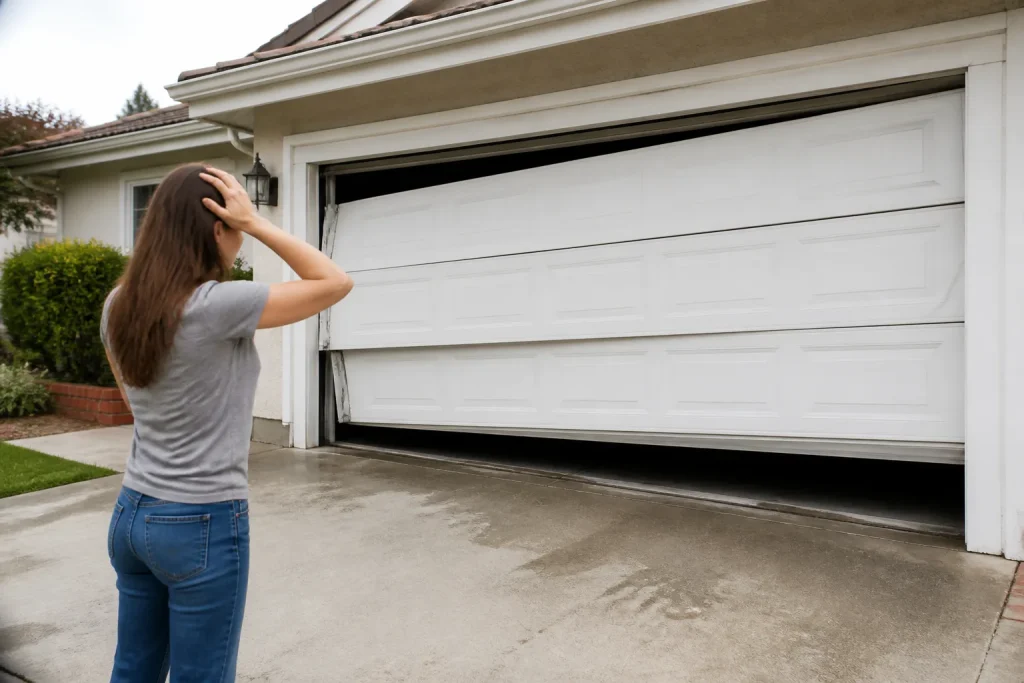
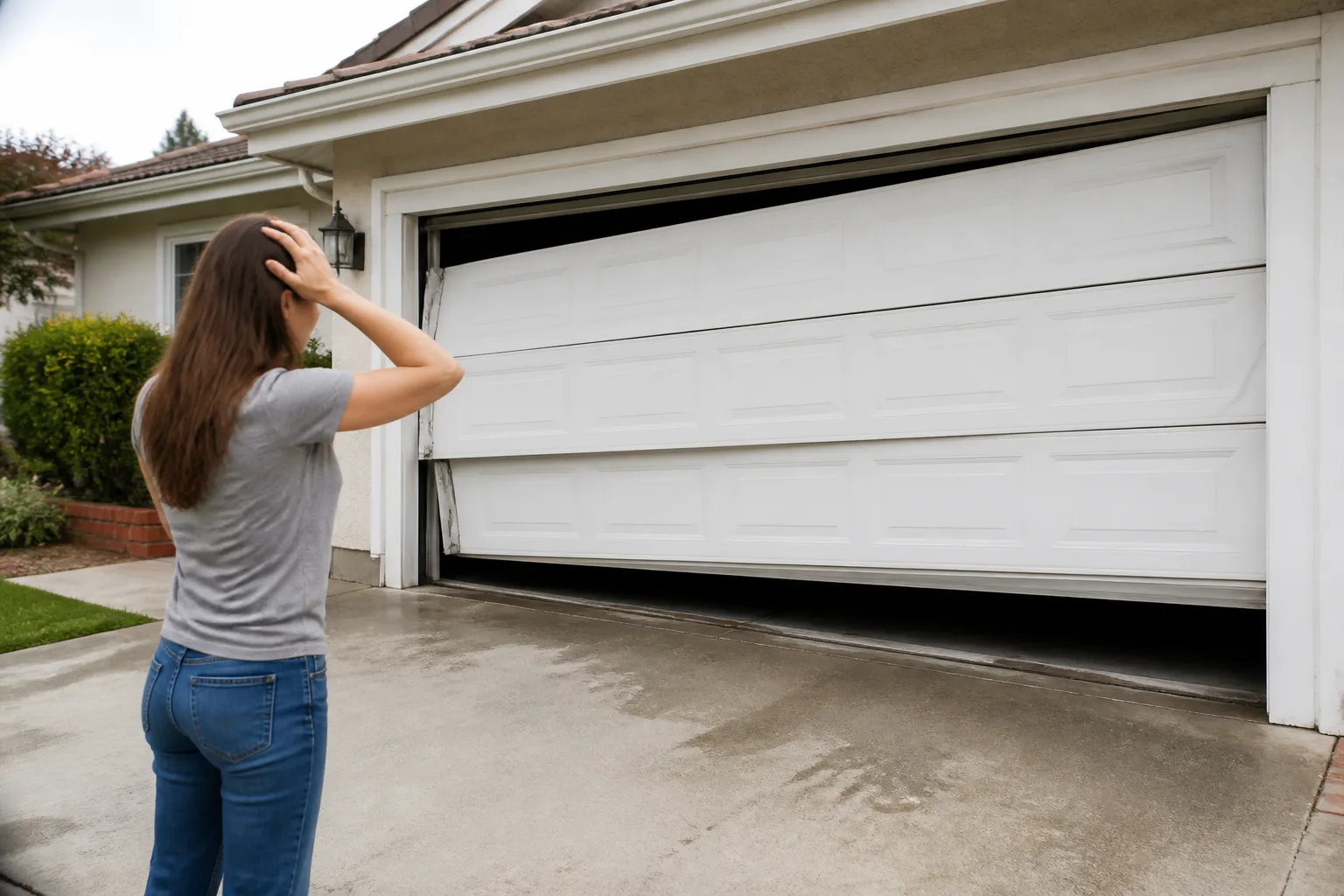
Emergency Garage Door Repair Near Me: What Rancho Cucamonga Homeowners Should Do First
When your garage door breaks at the worst possible moment, the first 20 minutes decide everything. The right moves keep a snapped spring from turning into a free-falling door, and they keep your house from sitting open to the street. Here’s what to do first: don’t panic, don’t yank the emergency cord, and don’t keep hitting the opener button hoping it’ll sort itself out. If you’d rather skip the reading and just get someone on the phone, call us at (833) 734-6940 for a free estimate.
We’ve been called out to homes all over Rancho Cucamonga where a homeowner made one small mistake in those first minutes that tripled the repair bill. A torsion spring snaps, the door won’t lift, and someone decides to “manually override” it without knowing what they’re actually disconnecting. That’s when a $200 spring replacement becomes a bent track, a shattered panel, or worse. So before we get into the step-by-step, let’s get one thing straight: you can handle the first 20 minutes smarter than most people do, and that’s the entire point of this post.
What the Red Emergency Cord Actually Does (And When Pulling It Is Dangerous)
That red cord hanging from your opener rail is a release mechanism. It disconnects the door from the opener trolley so the door can be moved by hand. What it does not do is make the door lighter. If your torsion spring snapped, the door still weighs anywhere from 130 to 250 pounds depending on the size and material. Pulling that cord with a broken spring means you’re now holding the full weight of the door, and if it’s in the up position, it can come down hard.
Here’s the one scenario where pulling the cord is dangerous: the door is open, the spring is broken, and you tug the release expecting to ease it down gently. That door only has gravity and whatever’s left of your grip holding it. When it picks up speed, there’s no stopping it. We’ve repaired doors in Rancho Cucamonga garages where this exact move left a door resting on the hood of a car.
The scenarios where pulling the cord is actually fine: the door is fully closed and you need to manually lift it out of the way (unlikely with a broken spring, but possible if the opener motor failed and the springs are intact), or the door got stuck mid-travel and you need to manually get it closed with the springs still healthy. If you can hear the motor running but the door isn’t moving, the problem might be a stripped gear in the opener itself, not a spring failure. In that case, the cord is safe to use. But if there was a loud bang like a gunshot from the garage and the door suddenly wouldn’t move, that’s a spring. Leave the cord alone and keep reading.
How to Secure a Broken Garage Door in Rancho Cucamonga So It Can’t Move
Whether your door is stuck open or stuck closed, your priority is making sure it doesn’t become a hazard or an invitation. A door stuck open overnight in a Rancho Cucamonga neighborhood is a security problem you don’t need. A door stuck closed with a car inside is a logistics problem. Either way, the fix is the same tool: a pair of vice grips.
- If the door is open: Disconnect the opener (pull the cord only if the door is already resting safely, not hanging free). Get a stepladder and clamp a vice grip onto the track directly below one of the bottom rollers on each side. The vice grips act as physical stops. Then, if you have an open position where the door is partially lifted, ease it down onto those vice grips rather than letting it settle on its own.
- If the door is closed: Clamp vice grips above a roller on each track to prevent anyone or anything from trying to force the door up while you wait for a technician. This is especially important if the spring snapped while the door was down, because the door now has no lifting assistance and can jam if someone tries to muscle it open.
- If the door is partway down and stuck: Don’t try to move it. Clamp the vice grips above and below a roller on at least one side, then call someone who does this for a living.
This is a temporary safety measure, not a permanent fix. It keeps the door from becoming a danger while you arrange a repair. Most Rancho Cucamonga homes have a standard 7-foot door that weighs 140 to 180 pounds, and a spring under tension does most of that lifting work. You’re not going to out-arm-wrestle that door.
True Emergency vs. Urgent-But-Not-Emergency: Why the Difference Matters
Not every garage door failure is an emergency, even at 9 PM when it feels like one. Knowing which situation you’re in affects who you call, when you call, and how much the repair is likely to cost.
A true emergency means the home is unsecured or property is at risk. If the door is stuck open and you can’t get it closed, your house is open to the street. In Rancho Cucamonga, where garages are often the primary entry point and contain tools, bikes, and other valuables, leaving it open overnight is not an option. Likewise, if the door came down on a vehicle, that’s an immediate response situation. These are the calls where a same-day dispatch makes sense, even at odd hours.
Urgent-but-not-emergency means the door won’t open or won’t close properly, but you can physically secure it. Maybe the opener failed but the door is closed and safe. Maybe the door is noisy, jerky, or opening halfway. These problems need attention, but they don’t require a middle-of-the-night service call. They require a scheduled appointment, ideally within a day or two.
The distinction matters for your wallet, too. Emergency service calls in Rancho Cucamonga often come with after-hours premiums, which is fair work that costs more. But if your door is secured with vice grips and your home is not exposed, you can often wait until regular hours and pay normal rates. Use that information to make the right call rather than reacting purely on stress.
What to Tell the Technician So They Arrive With the Right Parts
When you call for emergency garage door repair, the person on the phone can only work with what you tell them. Most homeowners say “the door is broken” and hope for the best. Here’s what actually helps a technician show up prepared.
Three things make the difference:
- Spring wire diameter: Spring wire comes in common sizes like .207, .218, .225, .234, and .250 inches. If you can read the numbers printed on the spring coil (usually painted color-coded on the end, like red, blue, or gold), that tells the technician exactly what to bring. Color codes correspond to wire gauge and weight class, not brand.
- Door weight class: Most residential doors fall into the 90-150 pound or 150-250 pound category. A heavier wood or carriage-style door needs a heavier spring. If you know what your door is made of, say so.
- Opener model: Openers don’t all work the same way. If your problem is the opener rather than the springs, telling tech support it’s a LiftMaster or a Chamberlain or a Craftsman right away saves a trip back to the shop for a specific logic board or gear set. We work on all three daily, plus Genie, and knowing the model helps the technician grab the right diagnostic tools before leaving.
Beyond those three items, mention what you heard. A loud bang is a spring. A grinding noise while the motor runs is usually a gear. A humming without movement is often a capacitor or a stripped drive coupling. The more specific the detail, the fewer trips it takes to fix a system that was installed before Rancho Cucamonga subdivisions even had fiber internet.
How to Vet an Emergency Garage Door Company at 9 PM… in Under 2 Minutes
When it’s late and you’re stressed, every company’s Google listing starts to look the same. Here’s the fast filter: three checks that take less than two minutes total and weed out the majority of bad actors.
First: Check the service list. If the company also does plumbing, HVAC, landscaping, and handyman work, and garage doors are one of 18 services on their website, that’s a flag. Garage door systems have specific failure modes. They involve high-tension springs that can genuinely hurt someone when handled wrong. A specialist works on this daily. A generalist avoids touching half the door because they don’t carry the parts. Before you share your address, type the company name and “garage door repair” into a quick search and see if the garage door page is actually substantive or just a service-area page with a phone number.
Second: Ask one question on the phone. “What spring wire gauge do you carry on your trucks?” A technician who actually arrives prepared knows the answer (most carry .207, .218, .225, and sometimes .243). A dispatcher who dodges the question, or says they’ll have the tech call you back, probably works for a call center that subcontracts out the job. That’s how you get a “technician” who shows up in a personal vehicle with a socket set and a YouTube video.
Third: Look for brand names, not vague claims. A company that says they service “all major brands” but lists none is hiding behind a hedge. A company that specifically mentions LiftMaster, Chamberlain, Genie, Clopay, Amarr, Wayne Dalton, Craftsman, and Raynor is telling you their technicians have seen your opener before. That’s the difference between a 30-minute diagnosis and an hour of head-scratching on your dime. We name the brands we work on because we’ve been inside all of them, not because a marketing person added keywords.
At the end of those checks, you either have a specialist on the phone or you’re calling the next company on the list. Either way, you’ve spent two minutes well.
What Not to Do While You Wait (The Mistakes We Keep Seeing)
There’s a pattern to emergency repairs in Rancho Cucamonga, and it usually involves one of these four mistakes made in the waiting period. We want you to avoid them because we would rather fix the simple version of your problem than the version you made worse.
Don’t keep pressing the opener button. If the door isn’t moving, pushing the remote ten more times isn’t going to fix it. It may overheat the motor, strip what’s left of a gear, or burn out a capacitor that was fine before you got creative. One push, listen for the sound, note it, then leave it alone.
Don’t try to manually lift a door with a broken spring. Covered this above, but it bears repeating: the door weighs more than you think, and a free-falling panel does not care about your reaction time. Let the vice grips hold it.
Don’t “just remove the panels.” Some well-meaning DIY videos suggest taking out the hinges and removing the door section by section. What those videos don’t tell you is that the bottom panel on any Rancho Cucamonga home with a cable-operated system is attached to cables under spring tension. Unloading that cable without releasing the tension properly is exactly how missing fingers happen. Even a fully broken spring often has the companion spring still wound. Let a professional unmount your door.
Don’t leave it unsecured because “we’re home.” We get it, you’re inside, the door is stuck open, the garage is attached. You’d be surprised how often an open Rancho Cucamonga garage gets walked while the homeowners are watching TV in the next room. The vice-grip method takes three minutes.
The Bottom Line
An emergency garage door repair in Rancho Cucamonga doesn’t have to be a disaster. Secure the door with vice grips, figure out whether you’re in emergency or urgent territory, gather the spring gauge and opener model, and vet the company before you give them your address. The first 20 minutes set the tone for the entire repair. Wasted ones make it more expensive. Smart ones save you hundreds and keep the job simple.
If you’re in Rancho Cucamonga and need help, Bronze Garage Door Repair home is a garage-door-only specialist. We service everything from emergency spring replacements to full Garage Door Installation in Rancho Cucamonga. For a door that won’t close, call (833) 734-6940 for a free estimate, and we’ll tell you over the phone what we think is happening before we even roll a truck.
Related Services in Rancho Cucamonga
When your issue is the opener itself rather than the door, that’s a different repair path. See our Garage Door Opener Repair in Rancho Cucamonga page for how we diagnose LiftMaster, Chamberlain, Genie, and Craftsman openers specifically. For everything from a single broken panel to a complete system that’s seen better decades, see our main Garage Door Repair in Rancho Cucamonga page.
Frequently Asked Questions
Secure the door immediately. If it’s open, clamp vice grips onto both tracks below a roller to hold it in place. If it’s closed, clamp above a roller so no one can force it up. Do not pull the red emergency release cord if the spring is broken. Then call a garage door specialist and tell them the door has a snapped spring. For help in Rancho Cucamonga, call Bronze Garage Door Repair at (833) 734-6940.
It depends on whether your home is secured. If the door is stuck open and you can’t close it, that’s an emergency because your home is exposed. If the door is closed but won’t open, that’s urgent but not an emergency, and you can often wait until regular service hours. Either way, secure the door first, then call for repair.
Yes, if the springs are intact. Pull the red emergency release cord to disconnect the opener from the door, then lift by hand using the handles or bottom rail. If the door won’t lift when you try, the springs may be broken and the door is at its full weight. Don’t force it. Call (833) 734-6940 for a free estimate on repair.
Emergency service often carries an after-hours premium, but the repair itself depends on what broke. A snapped spring replacement may run different from an opener motor replacement or a track realignment. The best way to know is to call and describe what happened. Bronze Garage Door Repair gives free estimates before any work begins, so there’s no surprise on the invoice.
Written by the team at Bronze Garage Door Repair, serving Rancho Cucamonga since 2014.
Need Garage Door Help?
Call Bronze Garage Door Repair — licensed & insured, here with fast after-hours help in Rancho Cucamonga.
(833) 734-6940